
Picket Spacing Calculator
Equal gaps between pickets, pickets per section and the layout mark for each one.
Enter the fence length, the post spacing, the post and picket widths and the largest gap you want. The calculator finds the fewest pickets that keep every gap at or under that size, then the exact equal gap, so the first and last pickets sit the same distance from the posts.
Largest spacing you will use — sections are made equal
4x4 = 3.5", 6x6 = 5.5"
1x4 = 3.5", 1x6 = 5.5"
Calculation Results
Cut a spacer block 2 1/4" wide and hang every picket against it — start 2 1/4" from the post and the last gap comes out the same.
📱 More free Android calculators
Fencing, decking and drywall estimators from Dixon App Studio — all free on Google Play.
Smart Fencing CalculatorThis site
Fence posts, pickets, rails, concrete, gates and total project cost.
Get it on Google PlaySmart Decking Calculator
Deck boards, joists, footings, railings and material cost estimates.
Get it on Google PlaySmart Drywall Calculator
Drywall sheets, mud, tape, screws and finishing cost estimates.
Get it on Google PlaySod Calculator: Mulch, Topsoil
Sod pallets, mulch, topsoil and seed for the yard around your new fence.
Get it on Google PlayGravel & Stone Calculator
Gravel, crushed stone and base rock in tons and cubic yards.
Get it on Google Play🔧 Recommended Fencing Tools & Supplies
Disclosure: As an Amazon Associate I earn from qualifying purchases.

VEVOR Post Hole Digger,52cc 1450W Auger Digger,Gas Powered Earth Digger with Two Drill Bit 6''& 10''and 3 Extension Rods,for Farmland,Garden and Plant,EPA Certification,Black+Orange+White
$159.90
Check price on Amazon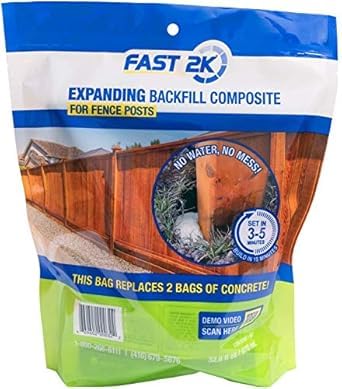
H.B. Fuller Fast 2K Post Anchor Mix | Expanding Composite Footing Compound (Fence, 1)
$27.99
Check price on Amazon

Ready Seal Exterior Wood Stain | Semi-Transparent Oil-Based Formula | Professional Grade Stain and Sealer in One | Ideal for Decks, Fences, Pergolas, Wood Siding & More | Gallon | Dark Walnut
$39.99
Check price on AmazonPrices as of Sep 30, 2026, 4:36 AM UTC. Product prices and availability are accurate as of the date/time indicated and are subject to change. Any price and availability information displayed on Amazon.com at the time of purchase will apply to the purchase of this product.
🛠️ How This Calculator Works
Each section is split into equal gaps with a gap against both posts, so n pickets make n + 1 gaps. The calculator takes the clear span between posts, finds the fewest pickets that keep every gap at or under your maximum, and then spreads the leftover space evenly so every gap is identical. Sections are made equal over the run rather than using standard bays with a short one at the end.
📐 Formula
Clear span = post spacing × 12 − post width · Pickets = ceil((span − max gap) ÷ (picket + max gap)) · Gap = (span − pickets × picket width) ÷ (pickets + 1) · Layout on centre = gap + picket width📝 Example Calculation
100 ft run, posts about 8 ft apart, 4x4 posts (3.5"), 1x4 pickets (3.5"), 2.5" maximum gap: Sections = ceil(100 ÷ 8) = 13 equal sections of 7.69 ft Clear span = 92.31 − 3.5 = 88.81" Pickets = ceil((88.81 − 2.5) ÷ 6) = 15 per section Gap = (88.81 − 52.5) ÷ 16 = 2.27" (2 1/4") 195 pickets for the run
💡 Pro Tips from Fence Builders
- Rip a spacer block to the exact gap and hang it from the top rail on a screw — it is faster and more accurate than measuring every picket.
- Dry-lay a section on the ground first: set the two end pickets, then check the gap before fixing the middle ones.
- Pickets swell and shrink. Green or wet pressure-treated pickets can be set a little tighter, because the gap opens as they dry.
- For a pool barrier the gap must not pass a 4" sphere, and 1.75" if the rails are less than 45" apart — use the preset.
- Order 5–10% extra pickets for splits, knots and the odd bowed board.
❓ Frequently Asked Questions
How do you calculate picket spacing?
Measure the clear span between the posts. Divide the span minus your maximum gap by the picket width plus the maximum gap and round up — that is the number of pickets. Then subtract the pickets' total width from the span and divide by the number of pickets plus one for the exact gap. A 72 inch span with 1.5 inch pickets and a 4 inch maximum takes 13 pickets at 3 3/4 inches.
How far apart should fence pickets be?
It is a design choice for most fences: tight 1/4 to 1/2 inch gaps for privacy, and gaps close to the picket width for a classic picket fence. Pool barriers are the exception — openings may not pass a 4 inch sphere, and only 1 3/4 inches where the horizontal rails are less than 45 inches apart (IRC Appendix AG105.2 / ISPSC section 305).
How many pickets are in an 8 foot section?
With 4x4 posts the clear span of an 8 ft on-centre section is 92.5 inches. With 3.5 inch pickets that is 15 pickets at a 2 1/2 inch maximum gap, 19 at a 1 1/2 inch maximum gap, or 26 at a 1/8 inch maximum gap. The calculator works it out for any width and gap.
What is the 4 inch rule for fence and railing spacing?
Building codes use a 4 inch sphere as the test for openings a small child could get through. Deck and stair guards may have no opening that passes a 4 inch sphere (IRC R312.1.3), and pool barriers follow the same rule, with a tighter 1 3/4 inch limit on some rail layouts.
Should there be a gap at the post?
Yes — this calculator puts a full gap at both posts so the section looks symmetrical and the end gaps match the rest. On a pool barrier the gap at the post counts as an opening too, so it has to meet the same limit.
Why not just use a standard 8 ft section?
Because the last section on a run is rarely exactly 8 ft. Spacing the posts evenly over the whole run makes every section identical, so the picket count and gap are the same everywhere and you can cut one spacer for the whole fence.
📬 Free Fencing Cost Guide
Get weekly fencing tips, material cost updates, and exclusive calculator guides — straight to your inbox.
No spam, ever. Unsubscribe anytime.
📝 Related Articles
🧮 You May Also Need
Related calculators for your fencing project








Picket spacing chart for an 8 ft section
Pickets per section and the exact gap for an 8 ft on-centre section with 4x4 posts, which leaves 92.5 inches of clear span.
| Picket | Max gap | Pickets | Exact gap |
|---|---|---|---|
| 3.5" | 0.5" | 23 | 1/2" |
| 3.5" | 1.5" | 19 | 1 5/16" |
| 3.5" | 2.5" | 15 | 2 1/2" |
| 3.5" | 3.5" | 13 | 3 3/8" |
| 5.5" | 0.5" | 16 | 1/4" |
| 5.5" | 2.5" | 12 | 2 1/16" |
| 1.5" | 4" | 17 | 3 3/4" |
Laying out the pickets
Hang the first picket one gap from the post, then work across with a spacer block cut to the exact gap. Check the last gap before you fix the final three or four pickets: if the posts are slightly out, split the difference over several gaps rather than leaving one odd gap at the end. On a racked fence the gap is measured square to the pickets, not along the sloping rail — see the fence on a slope calculator.
Pool fences and the 4 inch rule
Pool barriers are the one place the gap is set by code. The model pool code (IRC Appendix AG105.2 and the ISPSC) does not allow any opening that passes a 4 inch sphere, and where the tops of the horizontal rails are less than 45 inches apart — so the rails could be climbed like a ladder — vertical members may be no more than 1 3/4 inches apart. Local codes can be stricter, so check with your building department and see the pool fence calculator for the rest of the barrier.
Related calculators
Count pickets by fence length with the picket calculator, price a classic front-yard fence with the picket fence calculator, or plan a board-on-board privacy fence with the board on board calculator. Post counts come from the post spacing calculator.