Best Fence Posts: Wood, Steel, Vinyl and the Hardware That Saves Them
Wood, steel and vinyl posts compared, the add-ons that stop rot and leaning, and how many posts and bags of concrete your fence needs.
As an Amazon Associate I earn from qualifying purchases. This guide is written from product specifications, building practice and our calculators — it is not a hands-on product test. Affiliate disclosure
Posts decide how long a fence lasts. For wood fences the best post is pressure-treated lumber rated for ground contact (or naturally rot-resistant species like cedar heartwood or black locust), set below the frost line with drainage under it. Steel posts outlast wood in the ground; vinyl systems use sleeves over a structural core.
This guide covers the post types and the hardware that protects or rescues them, with counts from our fence post calculator and depth from the post depth calculator.
Compared by type
Pros and cons describe each type from its specifications. The product in each row is a current, well-rated option of that type on Amazon, refreshed twice a day — check the listing's specifications against the “check” line before you buy.
Steel T-posts
Best for: Wire, farm, garden and temporary fences
 Splicing 6 ft Black Metal Fence Post, T Posts for Wire Fencing, 8-Pack$62.90View on Amazon →
Check: Length (height plus about 2 ft in the ground) and weight per foot
- Driven, not dug — fast to install
- Do not rot
- Studs hold wire clips at any height
- Not suited to wood privacy panels
- Need a driver and a puller
- Surface rust over time
Vinyl post sleeves
Best for: Vinyl fences, or covering a wood post for a clean look
 Thyle 1 Pcs 5 x 5 x 48 Inches(Actual 4.5 x 4.5) Post Sleeve Vinyl, White$52.99View on Amazon →
Check: Inside size to match the post (a 5x5 sleeve fits a true 4x4)
- No painting
- Covers an ugly or stained post
- Matches vinyl rails and caps
- Not structural on its own — needs a wood post, steel insert or concrete
- Can trap moisture against a wood core
- Colour choice is limited
Rot-protection sleeves and wraps
Best for: Wood posts set in concrete or soil
 Postsaver Pro-Wrap Standard | Pack of 10 | Fits 3x3” to 4x4" Square and 3” to 5" Round Posts | Fence Protector | Dual-Layer Rot Protector | Wood Protector | 20-Year Guarantee (10)$79.50View on Amazon →
Check: Length of the protected zone and whether it covers the ground line
- Shields the ground line, where posts rot first
- Cheap compared with replacing a post
- Works on new posts before setting
- Must be fitted before the post is set
- Does not help a post that is already soft
- Adds a step to every post
Drive-in post spike anchors
Best for: Short fences, mailboxes and light screens
 POSTYBAY 4 Pcs 16" Fence Post Anchor Ground Spike|Black Powder-Coated|4"x4"$43.99View on Amazon →
Check: Post size the socket fits and spike length
- No digging or concrete
- Keeps wood out of the soil
- Quick to install
- Not strong enough for tall privacy fences in wind
- Hard to drive in rocky soil
- Can loosen in soft ground
Post repair brackets and menders
Best for: Straightening a leaning or rotted post without digging it out
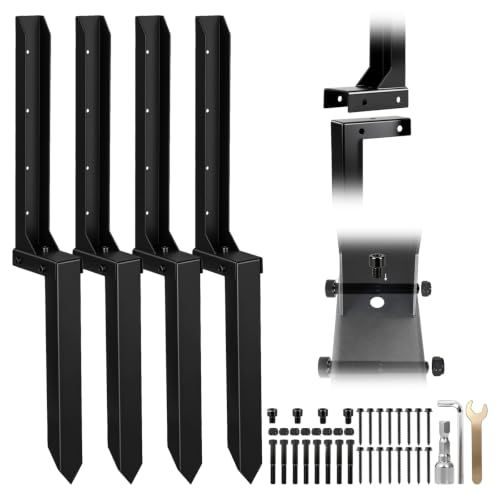 WAIWL Fence Post Repair Kit 33" 4 Pack, Fix Leaning 4x4/6x6 Wood Posts$59.99View on Amazon →
Check: Post size and how deep the bracket goes into the ground
- Much cheaper and faster than resetting a post
- No need to break out the old concrete
- Can save a fence section in an afternoon
- A stop-gap on badly rotted posts
- Visible on the post face
- Needs solid ground beside the old footing
| Type | Current option | Pros | Cons |
|---|---|---|---|
| Steel T-postsBest for: Wire, farm, garden and temporary fencesCheck: Length (height plus about 2 ft in the ground) and weight per foot | Splicing 6 ft Black Metal Fence Post, T Posts for Wire Fencing, 8-Pack$62.90View on Amazon → |
|
|
| Vinyl post sleevesBest for: Vinyl fences, or covering a wood post for a clean lookCheck: Inside size to match the post (a 5x5 sleeve fits a true 4x4) | Thyle 1 Pcs 5 x 5 x 48 Inches(Actual 4.5 x 4.5) Post Sleeve Vinyl, White$52.99View on Amazon → |
|
|
| Rot-protection sleeves and wrapsBest for: Wood posts set in concrete or soilCheck: Length of the protected zone and whether it covers the ground line | Postsaver Pro-Wrap Standard | Pack of 10 | Fits 3x3” to 4x4" Square and 3” to 5" Round Posts | Fence Protector | Dual-Layer Rot Protector | Wood Protector | 20-Year Guarantee (10)$79.50View on Amazon → |
|
|
| Drive-in post spike anchorsBest for: Short fences, mailboxes and light screensCheck: Post size the socket fits and spike length | POSTYBAY 4 Pcs 16" Fence Post Anchor Ground Spike|Black Powder-Coated|4"x4"$43.99View on Amazon → |
|
|
| Post repair brackets and mendersBest for: Straightening a leaning or rotted post without digging it outCheck: Post size and how deep the bracket goes into the ground | WAIWL Fence Post Repair Kit 33" 4 Pack, Fix Leaning 4x4/6x6 Wood Posts$59.99View on Amazon → |
|
|
Prices as of Sep 27, 2026, 8:10 PM UTC. Product prices and availability are accurate as of the date/time indicated and are subject to change. Any price and availability information displayed on Amazon.com at the time of purchase will apply to the purchase of this product.
Which post for which fence
| Fence | Usual post | Notes |
|---|---|---|
| Wood privacy or picket | 4x4 pressure-treated, ground-contact rated | 6x6 or steel at gates and corners for stiffness |
| Vinyl | Vinyl post, often with an aluminium or steel insert at gates | Follow the system's footing size |
| Chain link | Galvanised round steel | Terminal posts are larger than line posts |
| Wire, farm, garden | Steel T-posts with wood corner braces | An H-brace at every corner and gate |
| Wood fence, longest life | Galvanised steel posts with brackets | No rot at the ground line |
The best wood for fence posts is ground-contact pressure-treated pine (UC4A or higher) or naturally durable heartwood such as cedar, redwood or black locust. Sapwood of any species rots fast in soil. See cedar vs pressure-treated for the trade-offs.
How many posts, how deep, how much concrete
The fence post calculator, post depth calculator and concrete calculator run these formulas; the example uses the same functions.
Worked example: 150 ft of 6 ft fence, posts every 8 ft, one gate, moderate frost, loam soil
- Line posts: 20; gate posts: 2 → 22 posts
- Depth: at least 30 in, in a 12 in hole (three times the post width)
- Post length: about 9 ft each (6 ft above ground plus the buried depth)
- Concrete for all holes: about 65 bags of 80 lb mix (roughly 3 per hole)
22 posts of about 9 ft, set 30 in deep, and roughly 65 × 80 lb bags of concrete. Use heavier posts at the gate.
What to check before you buy
- Ground-contact rating on treated posts (the tag says UC4A, UC4B or 'ground contact'). Above-ground lumber rots quickly in soil.
- Straightness: sight down each post and reject twisted ones — a twist shows in every rail.
- Actual size: a nominal 4x4 is 3.5 in square. Sleeves, brackets and caps are sized for actual dimensions.
- Corrosion: hot-dip galvanised or coated steel near the ground, and fasteners rated for treated lumber.
- Drainage: set wood posts on 4–6 in of gravel and slope the concrete away so water does not pool.
Shop the types above
As an Amazon Associate I earn from qualifying purchases.
Splicing 6 ft Black Metal Fence Post, T Posts for Wire Fencing, 8-Pack
$62.90
View on Amazon →Thyle 1 Pcs 5 x 5 x 48 Inches(Actual 4.5 x 4.5) Post Sleeve Vinyl, White
$52.99
View on Amazon →Postsaver Pro-Wrap Standard | Pack of 10 | Fits 3x3” to 4x4" Square and 3” to 5" Round Posts | Fence Protector | Dual-Layer Rot Protector | Wood Protector | 20-Year Guarantee (10)
$79.50
View on Amazon →POSTYBAY 4 Pcs 16" Fence Post Anchor Ground Spike|Black Powder-Coated|4"x4"
$43.99
View on Amazon →WAIWL Fence Post Repair Kit 33" 4 Pack, Fix Leaning 4x4/6x6 Wood Posts
$59.99
View on Amazon →
Metal Fence Post 7FT, 15 Pack Heavy Duty T Posts for Lawn, Garden, Farm
$99.99
View on Amazon →Prices as of Sep 27, 2026, 8:10 PM UTC. Product prices and availability are accurate as of the date/time indicated and are subject to change. Any price and availability information displayed on Amazon.com at the time of purchase will apply to the purchase of this product.
Safety notes
- Call 811 (in the US) before digging post holes so buried lines are marked. It is free and required.
- Wear gloves and eye protection when cutting treated lumber, and do not burn the offcuts.
- T-post drivers are heavy: keep both hands on the handles and never lift the driver off the top of the post while striking.